NeolemonNeolemonvsStory.comStory.com

The same character, page after page.

Story.com turns a prompt into a finished video or storybook fast. Neolemon does the part those tools quietly skip: keeping your cartoon hero recognizable across every pose, expression, outfit, and scene of the book.

20 free credits. No card required.

4.5
Trustpilot, 94% 5-star
1M+
uses on our GPT
60%
publish to KDP
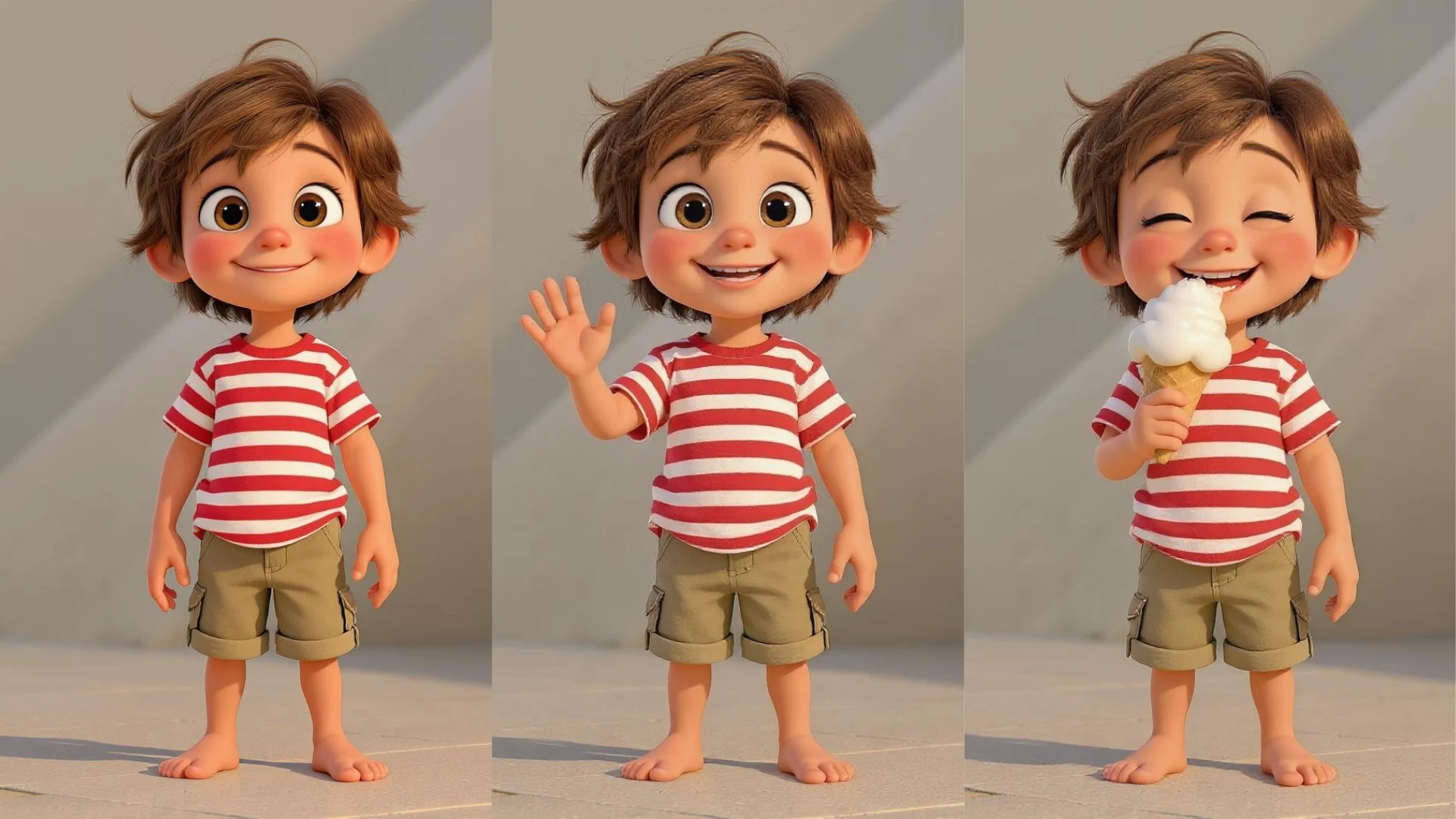
The same cartoon character generated in three poses with an identical face, hair, and outfit

One character. Three poses. Zero drift.

The 60-second verdict

Who each one is for.

You probably already use Story.com, or you are weighing it up. Here is the honest split before any of the detail.

Choose Story.com

Your goal is to turn an idea into a finished video, storybook, or trailer fast, in one workspace, paying per use with no monthly subscription.

Choose Neolemon

Your hardest problem is visual identity: keeping the same cartoon kid, dog, or shopkeeper on-model across 20-plus illustrations, with control over pose, expression, and outfit.

Use both

Draft a video or storybook in Story.com, then bring it to Neolemon when your protagonist starts drifting between pages.

The whole comparison in one line

Story.com generates the whole story. Neolemon keeps the character right.

Story.com is built to produce a finished thing from a prompt, video, storybook, or storyboard. Neolemon is built around the one job that breaks most books: the protagonist looking like themselves on every single page.

We want to be the Pixar in your pocket.
Sachin Kamath, Neolemon co-founder. That is the whole reason the product is character craft first, not publishing automation.

What you are comparing

Two tools, two jobs.

Most "Story.com alternative" pages get this wrong, calling Story.com a video toy or a writing app. Here is precisely what each one is, as of 2026.

Story.com

Story.com

A four-product story suite

Founded in 2024 by Steven Ebin, who hosts a long-running kids storytelling podcast. It is not one tool, it is a platform that runs in two modes: fast generation and controlled editing.

  • Instamovies. Prompt to short social video for TikTok, Reels, and Shorts.
  • AI Video Editor. A timeline with an AI movie agent, voiceover, subtitles, and long-form projects.
  • Storybook Publisher. Illustrated books from 8 to 48 pages, PDF export, and a Publish on Amazon path.
  • Storyboarding. Scripts and scenes turned into frames with camera angles.

Worth knowing: the product is real and the traction is real. Story.com claims more than 1 million users on its homepage and "10,000+ creators" on its pricing page. Those are two different numbers, neither audited, so take each as the company's own claim.

Neolemon

Neolemon

A character workshop

Formerly ConsistentCharacter.ai. Bootstrapped by two founders in Faro, Portugal. You build one anchor character, then direct it scene by scene. The book is what you make with the character.

  • Character Turbo builds the anchor from structured Description, Action, Background, and Style fields.
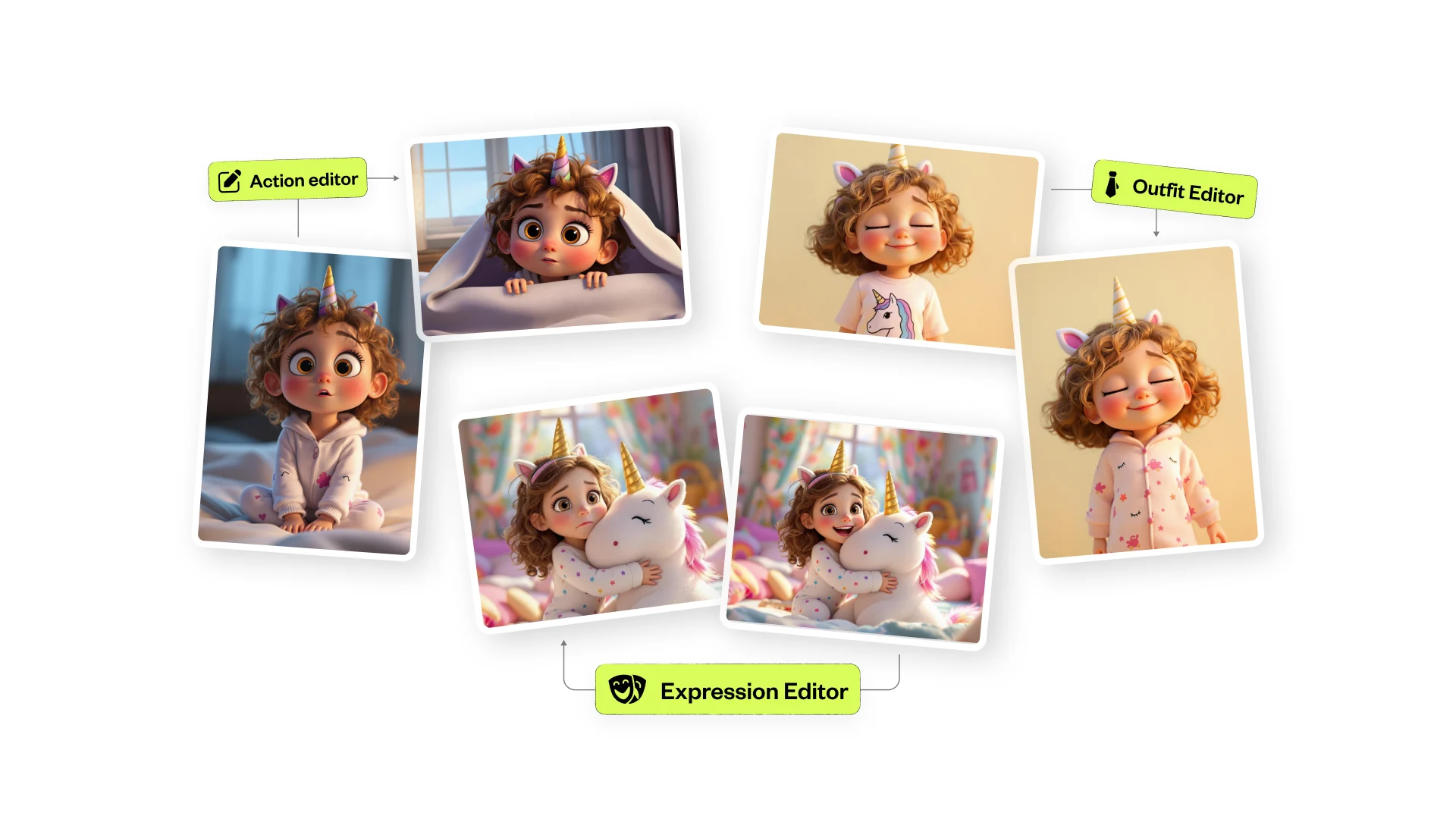
  • Action, Expression, Outfit, Perspective editors change one thing at a time, identity locked.
  • Multi Character and Story Scene Pro compose up to three characters with a background.
  • AI Canvas, Coloring Book Creator, Storyboard View take you from assets to a laid-out book.
Neolemon editors generating the same character in different poses and outfits

How consistency actually works

Lock the face. Change everything else.

Any tool can make one cute character. It falls apart around page 20, after your hero has been regenerated into thirty new scenes and quietly stopped being the same kid. Neolemon never re-rolls the character.

1

Anchor

One clean front view in Character Turbo. Every scene derives from this single reference image.

2

Pose it

Action Editor changes the pose. Face, outfit, and style stay exactly where they were.

3

Emote it

Expression Editor moves the eyes, brows, and mouth. Same child, twelve different feelings.

4

Compose it

Drop the character into a background, or compose several with Story Scene Pro. No identity blending.

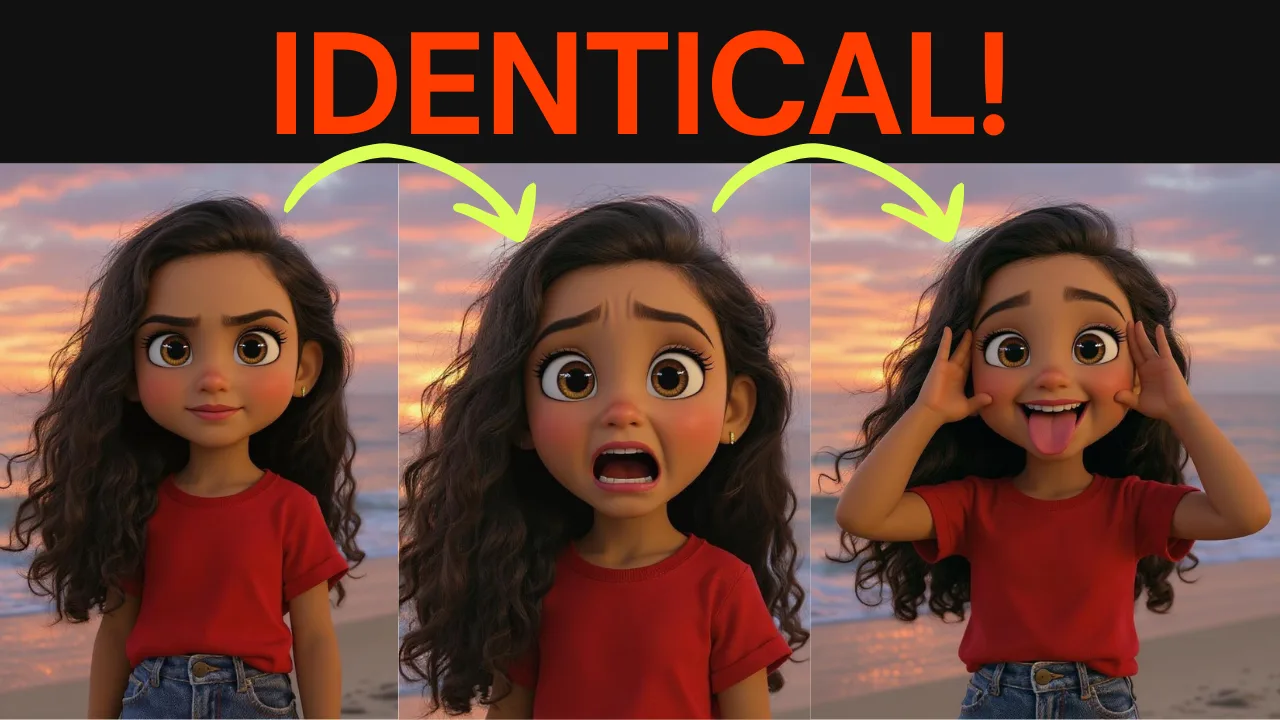
The same cartoon character in three expressions, identical face and outfit

Why it holds where others drift

Story.com claims its protagonist looks identical across illustrations, and that is a fair claim. The difference is control. There is a gap between "the same character appears on each page" and "I can deliberately put her in any pose, any expression, any outfit, and have her stay on-model."

Neolemon conditions every image on your one anchor and changes a single variable at a time. The same approach powers the developer model on Segmind: a required character reference plus an optional pose reference. It is a workflow for controlling consistency, not a wish for it.

The honest part about video

If you want motion, Story.com wins. Then it needs frames.

Story.com is a real AI video platform with a timeline, an AI movie agent, voiceover, and captions. Neolemon is not a video studio, and we will not pretend otherwise. We make the consistent frames the motion is built from.

Step 1, Neolemon

Build the consistent frames

Generate your character on-model in every key pose and expression you need. This is the part that breaks downstream if you skip it.

Step 2, motion tool

Animate the frames

Feed those stills into Story.com, Runway, Kling, Higgsfield, or CapCut. We have published a public workflow pairing Neolemon stills with Higgsfield motion.

Result

A character that stays itself

Motion is easy to add and easy to redo. Identity is the expensive part to fix once it has drifted across a scene.

Do not fight Story.com on video. Use Story.com on video. If your end product is a clip or a trailer, it is the more direct tool. If your end product is an illustrated book, the frames are what matter, and that is our lane.

Feature by feature

The full comparison.

Grouped by what you are actually deciding on. Where Story.com is the stronger pick, it says so plainly.

Capability Story.com Neolemon
Character control
Consistency across pagesClaimed, at the book levelThe core product: anchor plus editors
Dedicated pose editorNot a documented discrete toolAction Editor
Dedicated expression editorNot a documented discrete toolExpression Editor
Outfit and camera angleNot documented separatelyOutfit and Perspective Editors
Multi-character scenesInside the book or video flowMulti Character plus Story Scene Pro
Reusable across a seriesBook or session boundAnchor image you reuse anywhere
Story and book production
AI writes and paces the storyYes, age, tone, lesson, page turnsVia companion GPTs, not in-app
Photo to cartoon characterNot the headline workflowPhoto to Cartoon
Coloring-book pagesNo documented workflowColoring Book Creator, one click
Drag-and-drop layout canvasStorybook layout and video timelineNative AI Canvas
PDF exportYes, storybook PDFYes, a storyboard, not a print interior
Amazon KDP publishing flowYes, integrated, with trim instructionsNo, you lay out and upload yourself
Video and audio
AI video generationYes, Instamovies and a timeline editorNo, frames only, animate downstream
Voiceover, narration, captionsYes, built inNo
Pricing and access
Free way to tryFree planning, paid final output20 credits, no card
Billing modelPay-per-use credits, no subscription$29 a month, flat, 600 credits
Commercial rightsPaid credits, free output needs creditEvery paid plan
Developer APINot a headline productSegmind V3 API

A blank discrete editor for Story.com means the capability is not published as a separate tool, not that revision is impossible. Story.com cost varies by output and shows before you generate. Check both live pages before you buy.

Pricing

One avoids subscription waste. One avoids iteration waste.

Story.com is transparent about the price of credits, and quieter about the cost of a finished book until you are inside the workflow. Here is the honest version of both.

Story.com

A prepaid wallet. You add funds, credits drain as you generate, and they do not expire on the standard plan.

PackPriceStory.com frames it as
Tester$10 = 1,000Validate the workflow
Iteration$20 = 2,000Expect variations and revisions
Batch$50 = 5,000Creating in batches
ScaleCustomProducing at scale
  • No subscription, and credits do not expire. Genuinely nice for bursty, one-off projects.
  • The free tier covers planning, scripts, and initial frames, not final video, books, or export.
  • No public rate card for a finished book or a 30-second video. Cost shows before each generation.
  • Credits are non-refundable and non-transferable. Free-credit output requires attribution.

Neolemon

$29 / month, flat

600 credits, about 150 Character Turbo generations. Plus a free trial: 20 credits, no card.

  • Character Turbo is 4 credits an image. The math is simple before you start.
  • Prompt Easy, Randomize, Translate, Speech, and AI Improve cost zero credits.
  • Commercial-use rights included on the only paid plan.
  • You iterate a full picture book without watching an unpredictable wallet drain.
See Neolemon pricing

Story.com is genuinely cleaner for occasional use, one book this summer, one trailer at Christmas, nothing in between. Neolemon is cleaner for active iteration. Do not compare sticker prices, compare how many usable final scenes you have after the revisions a real picture book takes.

Proof, with names

What people actually ship.

Most comparison pages invent quotes here. We will not. Both sides are real, named, and public, the good and the honest gaps.

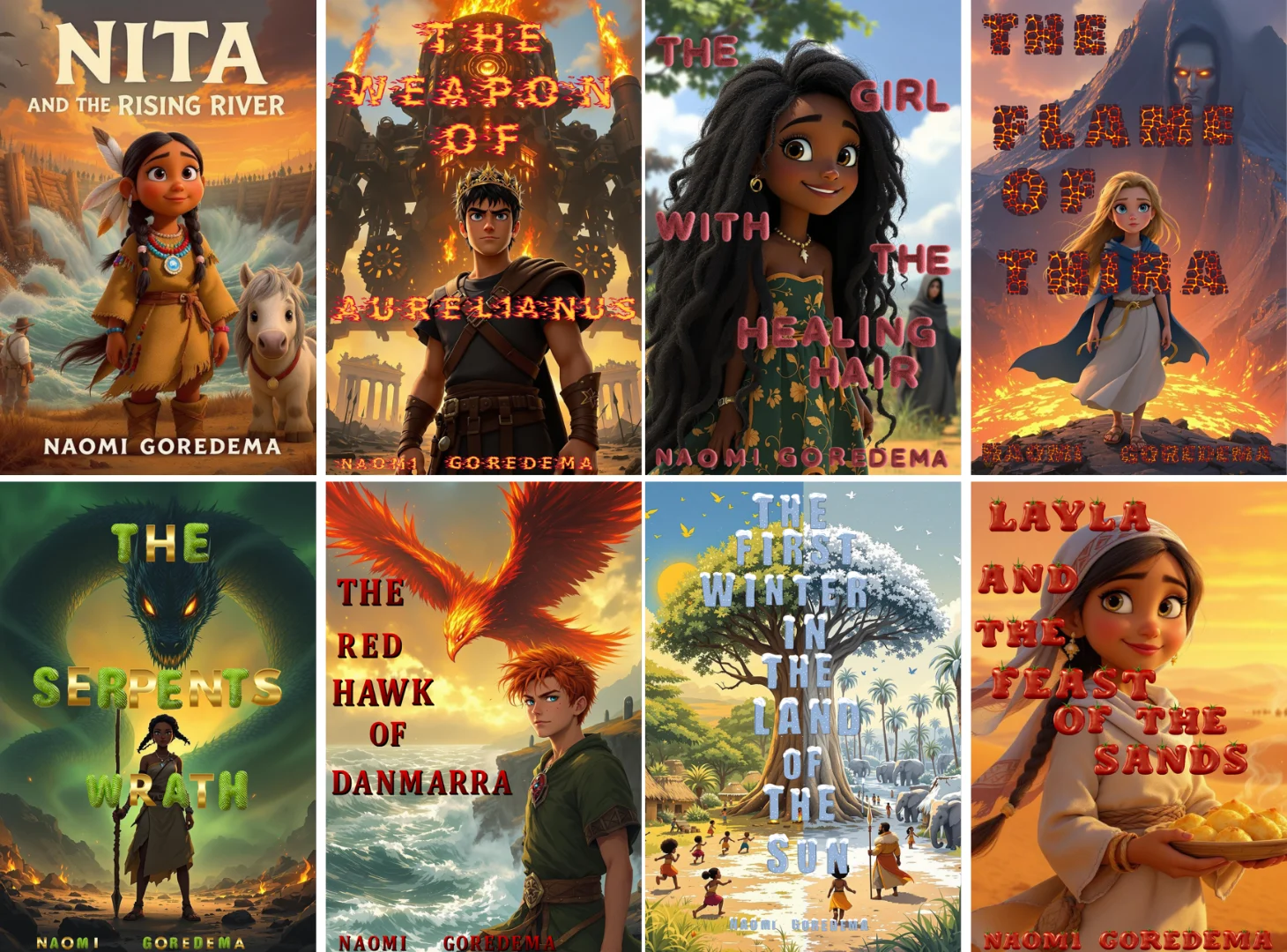
Finished children's book covers illustrated with Neolemon by author Naomi Goredema
20 books in 4 months. Naomi Goredema, children's author. Her old workflow took three days per character. Neolemon got it to thirty seconds.

On Story.com

Story.com is a young product, so the named-review pool is thin and launch-heavy. The praise is for the first-draft magic. The clearest gripe is about free-tier watermark disclosure.

"The quality of the video is insane."

Cherry Yuan, on Product Hunt

Created his "childhood story in seconds."

Jesus Castillo, on Product Hunt

Unpaid videos carried watermarks, and users should be warned earlier, before sign-up.

Kim Ammy, on Product Hunt

The wow is instant media from a prompt. That is a real win, and a different feeling from keeping one illustrated character steady across a book.

On Neolemon

Our proof is finished work, not tool reviews.

  • Patricia Wonsey, a former educator, made over $1,000 in her first week selling coloring books built on Neolemon.
  • Brian McPhee shipped an 83-page book with 47 illustrations, 13 characters, and 12 stories.
  • Erica Weinstein built an 8-scene rom-com storyboard with the same cast across every scene.
  • "This app has become an invaluable tool in my creative process." Joanne Mohammed, children's author.
4.5★★★★★34 reviews, 94% 5-star on Trustpilot

Credit where it is due

Where Story.com wins.

We will go first. These are things Story.com does better than us. If one of them is what your project needs, it is the right tool.

Idea to video in one flow

A real timeline, an AI movie agent, voiceover, and captions. If your end product is a video, this is the tool.

Idea to published storybook

An integrated path from idea to PDF to a Publish on Amazon flow, with documented trim and bleed settings.

Help with the writing

It asks for reader age, tone, lesson, and page rhythm, real scaffolding for a first-time author with a rough idea.

Pay-per-use, no subscription

Credits do not expire. Make one book this summer and a trailer at Christmas, and pay nothing in between.

Model breadth

An orchestration layer routing work across leading third-party video, image, and audio models as they improve.

The first-draft wow

Reviewers call it instant and impressive. If your journey is "try it Saturday and feel amazed," it nails that.

Take it seriously and build something good. If you later hit the wall most authors hit, the protagonist drifting between page 3 and page 27, you know where we are.

Our turn, same rules

Where Neolemon wins.

Cartoon-only, on purpose. Built around the one job that breaks every "make me a story" tool the moment you care about the details.

Identity is the product

Not a feature claim bolted onto a book flow. The whole tool exists to hold one cartoon character on-model.

Per-trait revision control

Change the pose without touching the outfit. Change the expression without touching the pose. If you are picky, the picky tool wins.

Built for a series

A reusable asset library: front view, side view, pajamas, school uniform, plus a best friend and a pet. Reuse across many books.

Predictable production budget

A flat $29 for about 150 generations beats a wallet draining at unpredictable rates through a full picture book.

Cartoon focus is a feature

We dropped photoreal in 2025 to tune the styling for illustrated work, books, comics, classrooms, and mascots.

Coloring books for KDP

Any image becomes a print-ready coloring page in one click, a high-volume KDP category Story.com does not cover.

Route yourself

Who should pick which.

Story.com

  • You want to turn a story into an AI video, trailer, or short.
  • You want the fastest route from a rough idea to a complete book.
  • You want help writing, pacing, and structuring the story itself.
  • You want an integrated Amazon publishing and export path.
  • You make things occasionally and prefer pay-per-use over a monthly plan.

Neolemon

  • The character is the product, not just one part of the book.
  • The same hero appears on every page of a 24 to 32-page book.
  • You need control over pose, expression, outfit, and angle separately.
  • You are building a series or a recurring mascot.
  • You want a coloring-book workflow, or API access for client work.

Use both

  • Story.com to draft a story or a promo video fast.
  • Neolemon for the controlled final illustrations you can direct.
  • Make the book in one, then make the read-aloud trailer in the other.

The switch

Moving a book from Story.com to Neolemon.

Hit the wall on character drift or per-trait control? Here is the path authors actually take, start to finish.

  1. 1

    Find your anchor

    Download your best protagonist from Story.com, or take a clear photo of a kid, pet, or person.

  2. 2

    Start with 20 credits

    Free, no card. Cartoonize your image, or generate a fresh anchor in Character Turbo.

  3. 3

    Stress-test it

    Five poses, five expressions, one outfit swap. If it holds, the rest of the book is downhill.

  4. 4

    Build single-character pages

    Action Editor plus Expression Editor on your anchor, one page at a time.

  5. 5

    Build the busy scenes

    Multi Character for two, Story Scene Pro with a background for three plus a directed shot.

  6. 6

    Compose with text

    Assemble pages in AI Canvas, add text overlays, leave room for the copy, and export.

  7. 7

    Organize in Projects

    One project per book. Sequence panels in Storyboard View as the book takes shape.

  8. 8

    Lay it out for print

    The storyboard PDF is not a print interior. Finish in Canva, Affinity, or Vellum at your trim size.

  9. 9

    Publish and disclose

    Upload to KDP, and disclose AI-generated images, which KDP requires regardless of the tool.

No half-truths

What to watch out for, on both sides.

Story.com

  • The public pages show the price of credits, not the cost of a finished book until you generate.
  • Free covers planning and initial frames. Final video, books, and export need paid credits.
  • Credits are prepaid, non-refundable, and non-transferable.
  • Free-credit output requires attribution to Story.com when shared. Use paid credits to publish.
  • Its terms put Amazon policy compliance, rights, and acceptance entirely on you.
  • Its terms allow generated content and metadata to help train and improve AI integrations.

Neolemon

  • Not an animation studio. We make frames. Pair with Story.com, Higgsfield, Runway, or Kling for motion.
  • The storyboard PDF is a storyboard, not a print-ready KDP interior. Verify print specs separately.
  • Cartoon-only since 2025. For photoreal humans, Midjourney is the right tool.
  • Three or more characters in one frame still pushes current AI. Expect to iterate.
  • Fine details, fingers, intricate patterns, can vary across generations.
  • Commercial-use rights are not copyright ownership. The law is still evolving, and KDP requires AI disclosure.

We would rather lose a buyer to honesty than win one with a half-truth.

The wider field

What about the other alternatives?

If you searched "Story.com alternative," you have seen these names too. Here is the honest lay of the land.

Runway, Pika, Kling, Sora

Video-first generators. Strong for motion, like Story.com's video side. None is built around directing one illustrated character across a book.

MyStoryBot, ReadKidz, Childbook.ai

Children's-book generators. They make a finished personalized story fast, the same book-first shape as Story.com's Storybook Publisher.

Neolemon

The one on this list built for illustration control, not story or video generation. If consistency across pages is the problem, this is the different category.

Questions

What authors ask before switching.

Is Neolemon a Story.com alternative?+

Yes, if you want an alternative built around consistent cartoon characters and illustrated story visuals. No, if you mainly want AI video editing or Story.com's integrated storybook publishing. The tools overlap on illustrated output and diverge sharply on video and end-to-end publishing.

Which is better for AI videos?+

Story.com. Its AI Video Editor, Instamovies, and timeline are built for video output. Neolemon generates consistent frames and key visual assets, and motion happens in tools like Story.com, Runway, Kling, Higgsfield, or CapCut.

Which is better for keeping the same cartoon character across many scenes?+

Neolemon. It exposes dedicated editors for pose, expression, outfit, and camera angle, plus reference-anchored composition like Story Scene Pro and AI Canvas. Story.com claims protagonist consistency too, but the per-trait control surface is more developed on Neolemon.

Which is better for children's books?+

It depends on what is hardest. If getting from idea to a finished, KDP-ready book quickly is the hard part, Story.com's Storybook Publisher is more end-to-end. If keeping the same character looking like herself across 24 to 32 pages is the hard part, Neolemon is more specialized. Many authors write in one and illustrate in the other.

Which is cheaper?+

It depends on volume. Story.com is pay-per-use, $10 for 1,000 credits, with no subscription and credits that do not expire. Neolemon is $29 a month for 600 credits, with 20 free to start. For one-off or bursty creators, Story.com's wallet is easier. For active monthly iteration on a book or series, Neolemon's flat fee is more predictable.

Does Story.com have character consistency?+

Yes. Story.com claims its protagonist looks identical across illustrations in Storybook Publisher, and that continuity holds across video scenes. We will not pretend otherwise. The honest difference is that Neolemon exposes more dedicated tools for controlling that consistency, changing pose without disturbing the outfit, expression without disturbing the pose, and so on.

Does Neolemon replace Story.com's Storybook Publisher?+

Not one-to-one. Storybook Publisher is closer to an end-to-end publishing tool with a documented Amazon KDP path. Neolemon is a character-and-scene workflow, and its storyboard PDF export is a storyboard, not a print-ready KDP interior.

Can I use Story.com's free tier to fully publish a book?+

No. Final video creation, book creation, complete project export, and publishing to third-party platforms require paid credits under Story.com's terms. The free tier covers planning, scripts, outlines, characters, and initial frames.

Can I publish AI-generated children's books on Amazon KDP using either tool?+

Yes, with the standard caveats. KDP requires you to disclose AI-generated text and images on submission. You are responsible for content guidelines, rights, and your relationship with Amazon. Commercial-use rights on paid plans are not the same as copyright ownership, so get your own legal read if it matters.

Does Neolemon support photorealistic humans?+

No. Neolemon deprecated photorealistic styles in 2025 and is cartoon-only. Story.com is broader on style range. For photoreal human work, we point you to Midjourney.

Does Neolemon offer a developer API?+

Yes. The consistent-character-AI-neolemon-v3 model is hosted on Segmind with a documented API surface, useful for agencies and pipelines. Story.com's API was on its roadmap at launch, so verify current status with Story.com before architecting an integration.


The whole comparison, in one question.

When the book is finished, what was the hard part? If it was turning an idea into a video or a book fast, you wanted Story.com. If it was keeping your hero on-model across every page, you wanted Neolemon.

Does your protagonist drift between page 3 and page 27?

Run one character through an action edit, an expression edit, and an outfit edit, and watch the face stay put. 20 free credits, no card.

If Story.com is the right tool for your project, use it. If keeping the character consistent is the part that is breaking your book, that is what we built.